11
Jun
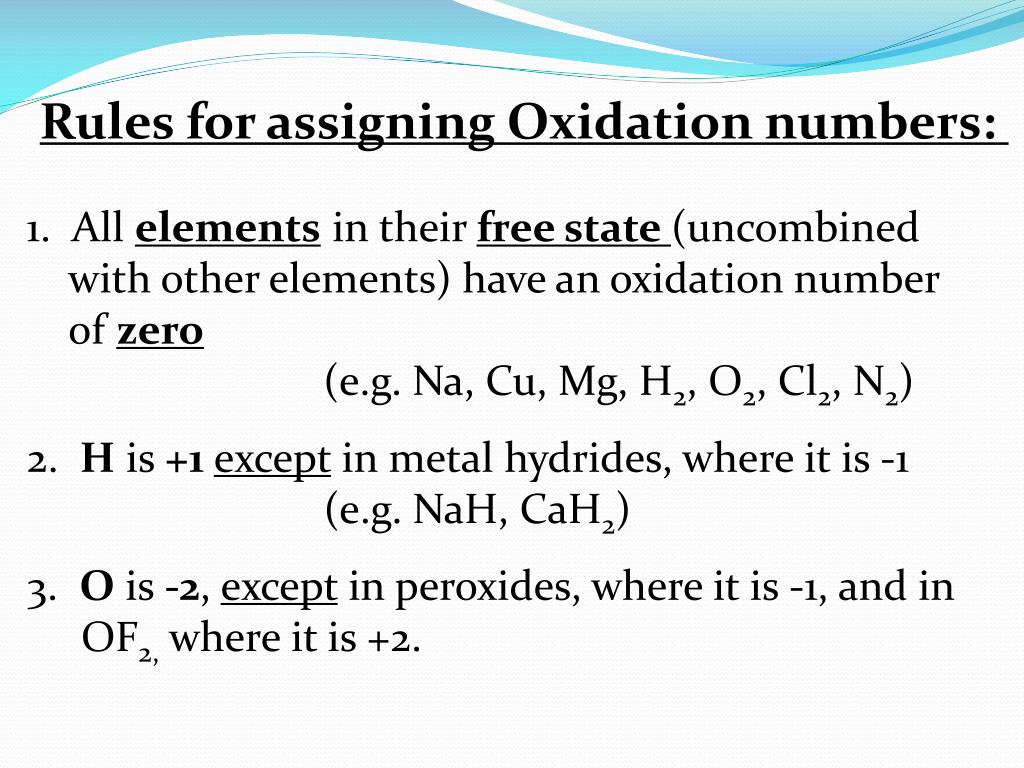
In that case it becomes -1. The oxidation number of oxygen is almost always -2.
Rules for assigning oxidation states. RULES FOR ASSIGNING OXIDATION STATES. Chemists use the following ordered rules to assign an oxidation state to each element in a compound. Any pure element has an oxidation state of zero.
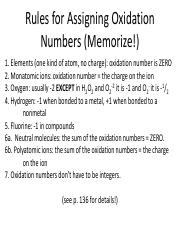
The sum of the oxidation states of all atoms forming a molecule or ion is the net charge of that species. Rules For Assigning Oxidation States. For free elements the oxidation state is zero.
Fes O2g O3g H2g Hgl Hgg Ss etc. For monoatomic ions the oxidation state is given by the charge on the ion. Cl–1 Fe22 Fe33 S2–2 Ca22 H 1 etc.
Rules for Assigning Oxidation States Rules are in order of priority 1. Free elements have an oxidation state 0 2 Nas Cl 2 g Na 0 and Cl 2 0 2. Monatomic ions have an oxidation state equal to their charge NaCl Na 1 and Cl- -1 3.
A the sum of the oxidation states of all the atoms in a compound is 0 NaCl Na 1 and Cl- -1 sum. 1 -1 0. Rules for Assigning Oxidation Numbers.
The convention is that the cation is written first in a formula followed by the anion. For example in NaH the H is H-. In HCl the H is H.
The oxidation number of a free element is always 0. The atoms in He and N 2 for example have oxidation numbers of 0. Rules For Assigning Oxidation States.
For free elements the oxidation state is zero. 2 g Hgl Hgg Ss etc. For monoatomic ions the oxidation state is given by the charge on the ion.
Cl–1 Fe2 2 Fe3 3 S2–2 Ca2 2 H 1 etc. 5 Rules to Assign Oxidation States. To work out the oxidation state we must apply the following rules.
1 The oxidation state of an element is always zero. Copper atom in Cu has an oxidation state of 0. Oxidation numbers are assigned to elements using these rules.
The oxidation number of an element in its free uncombined state is zero for example Al s or Zn s. This is also true for elements found in nature as diatomic two-atom elements. And for sulfur found as.
The oxidation number of oxygen is almost always -2. The only time oxygens oxidation number shifts is when it is part of a class of compounds called peroxides. In that case it becomes -1.
Similarly the oxidation number of hydrogen is almost always 1. Oxidation states are assigned to atoms by a set of rules based on the arrangement of electrons and bonds around that atom. This means each atom in the molecule has its own oxidation state which could be different from similar atoms in the same molecule.
These examples will use the rules outlined in Rules for Assigning Oxidation Numbers. EACH Ba has an oxidation state of 2 In. EACH Ca has an oxidation state of 2.
Has an oxidation state of 2. The oxidation state of any ion is its charge. Ex a Fe3aq ion has an oxidation state of 3.
Any atom that is uncombined and has a neutral charge has an oxidation state of 0 this is called the elemental state. Also since the overall charge of the formula is 2- then it follows from rule 6 that the oxidation state of the chemical formula is -2. Now from rule 7 again we must ensure the sum of the oxidation numbers of atoms in the formula add up to the oxidation state of the formula.
Different point through which neutral molecule or any specie have 0 oxidation noThis video is about. Oxidation State and Rules for Assigning Oxidation State. The rules discussed here are based on the Book.
Principles and Modern Applications 11th Edition 2016 by Ralph H. All elements in their free state uncombined with other elements have an oxidation number of zero for example Na Cu Mg H 22 O Cl 22 N. H is 1 except in metal hydrides where it is -1 for example NaH CaH.
Chemistry oxidation state and 9xidation number rules for assigning oxidation number for more lectures of chemistry tell us in comments. Rules for Assigning Oxidation States 1. The oxidation state of an atom in an element is 0.
For example the oxidation state of each atom in the substances Na s O2 g O3 g ozone and Hg l is 0. Rules for Assigning Oxidation States. The oxidation state of an atom in an element is 0.
For example the oxidation state of each atom in the substances Nas O₂g O₃g and Hgl is 0. The oxidation state of a monatomic ion is the same as its charge. For example the oxidation state of the Na ion is ¹.
Previous post
Rules for dividing exponentsNext post
Rule for dividing exponents